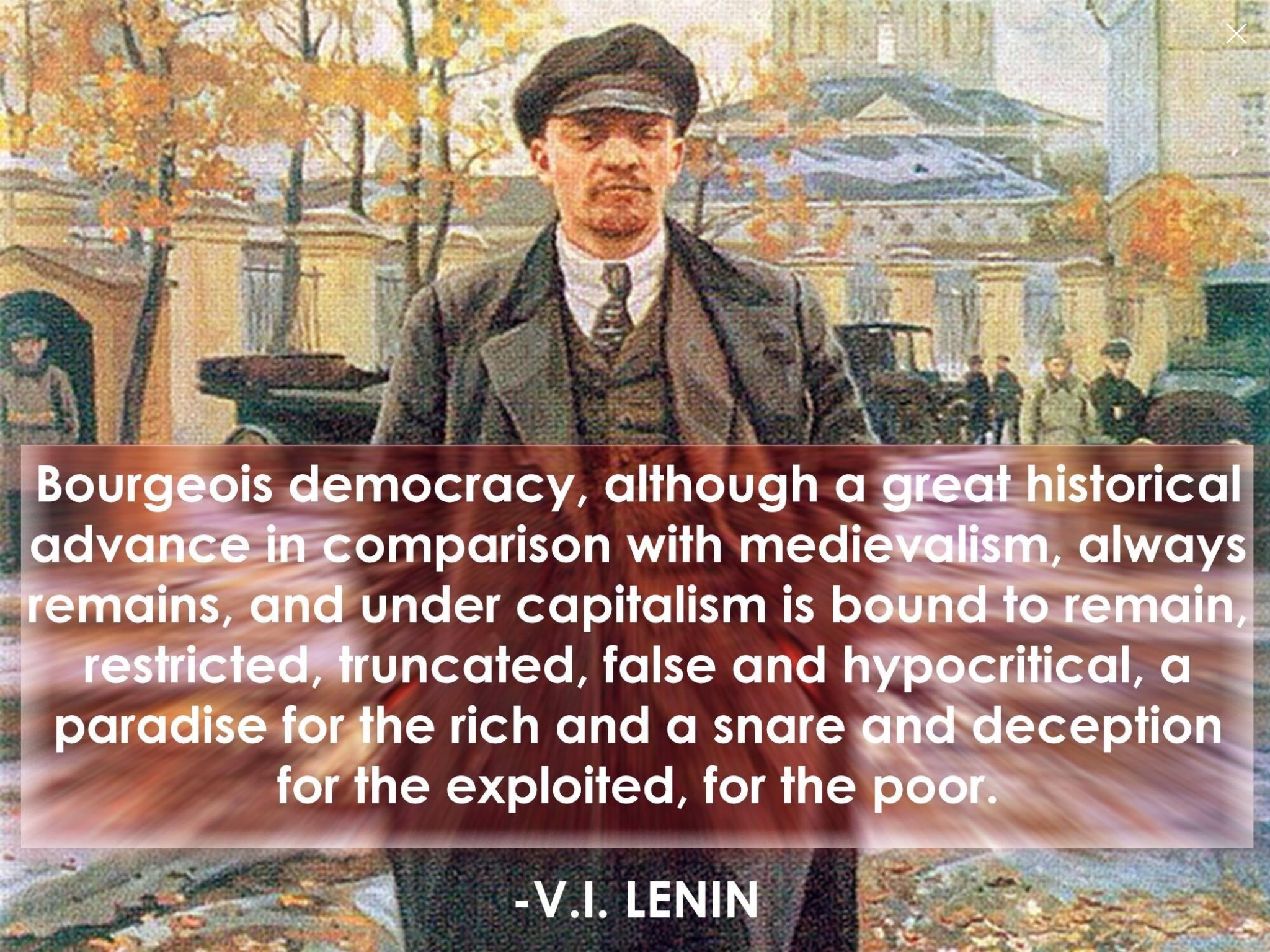
After the death of Joseph Stalin in 1953 and Khrushchev along with his acolytes seizing power in 1956, Anti-Revisionist Marxists, first Maoists and later Hoxhaists, criticised the Khrushchevites for their revisionist beliefs and practices. The rise of Khrushchevism lead to the Sino-Soviet split in 1961. It is these revisionist and opportunistic lines of “Anti-Stalinism” which caused the collapse of the Soviet Union and the dismantlement of the state socialist system of the eastern bloc over a period of 35 years, 1956-1991.
To understand the process of the restoration of capitalism in Soviet society, it is necessary to understand the principles of Khrushchevism and how it differs from Marxism-Leninism. Nikita Khrushchev believed that it was possible for a capitalist society to peacefully evolve and transition into a socialist society via gradual democratic reformism. He also supported the notion that capitalist and socialist states could peacefully coexist. Socialism, as in the public and cooperative ownership of industry and agriculture with central state planning and distribution, has never been achieved through means of democratic constitutional reforms. In order for a socialist mode of production to be established by the ballet box, industrialists and entrepreneurs who ruled bourgeois society would have to stand idly by as their assets were placed into the public sector and their property nationalised. As for peaceful coexistence proposed by Khrushchev, this quixotic, foolish idea could be easily rejected with the fact that the capitalist imperial great powers always were focused on attempting to destroy socialism even before the October revolution. The early Russian Soviet Federative Socialist Republic was invalided with a coalition of 17 nations upon its inception. The police force and military were always used to forcibly crush labour and general strikes and protests by radicalised workers. The West supported Hitler in his early reign due to his extreme Anti-Communist and Pro-Industry rhetoric. It is directly opposed to capitalists’ interests that a bourgeois democratic government take a neutral, rather than hostile, stance to the existence of a socialist republic. Khrushchev replaced the authoritarian Stalinist era politics used to purge opportunists and revisionists from the party with a more relaxed a politically liberal atmosphere, which allowed for right-wing opportunist and Marxist revisionist politicians to take power.
After Stalin, Khrushchev took power and led the whole Soviet social system down capitalism. He represented the new state-monopoly bourgeois class which had sprung up from the ideological parts of the superstructure which had been left unchanged. Bourgeois ideas were able to be sowed into the party because of people who lived their lives under bourgeois society and lived by its ideas. There were those who were strong and socialist to the end and those who were very weak, like, Khrushchev who succumbed to it. There was a large amount of militarisation, too much to be called simply “militant defense of the revolution.” There was also its treatment of other socialist states as client states and upheld a line of “limited sovereignty.” The Comecon allowed the U.S.S.R. to exploit resources from these client states, for example, over 90 percent of Czechoslovakia’s uranium production, 94 percent of Bulgaria’s bauxite exports and 49 percent of its lead and 43 percent of Poland’s zinc went to the Soviet Union, etc.
What doesn’t make it imperialism? The U.S.S.R. under Khrushchev by that time stopped developing nations in order to reach more or less self sufficiency, and to supply the Soviet Union with raw resources. This is already financial capital. They export financial capital to, say, Cuba to develop their nickel and sugar industries, Cuba exports the nickel and sugar and the U.S.S.R. sells to them finished products. Technological development was barred in Uzbekistan, the U.S.S.R. wanted Albania to remain an agricultural country. So it is not an inappropriate usage, nor is it a misunderstanding of the Marxist definition because the USSR did have all the necessary characteristics that would make them imperialist. They had monopoly in industry, exported surplus capital in order to develop other nations’ economies, but this development only served to provide them with superprofits.
Basically, Khrushchev represented the interest of the growing bourgeois class. Classes don’t disappear under socialism, this is a mistake Stalin made and even to an extent, Mao and Hoxha, and it cost them gravely. Instead of continuing to get rid of the bourgeoisie in culture, ideology and the other branches of the cultural superstructure, they only focused the economic expropriation of the bourgeoisie, severing them from the state. The bureaucratic managers of the state owned means of production that became evident during Khrushchev’s take over shows how the bourgeoisie had obviously been growing, and through the class struggle, expressed themselves with their representative, Khrushchev, now in power.
Capital between banks and industries had already a firm relationship under the socialist period of the U.S.S.R. but this can’t be called financial capital since the U.S.S.R. was still a workers’ state. However, during Khrushchev’s take over, the means of production were effectively severed from the workers, despite there being Soviets and state planning. We know for a fact that the democratic structures of society are meaningless if the bourgeois class rules them. It is evident that this became financial capital in that the USSR began to invest more in its allies and extract resources from them, greatly hindering them from their task of industrialisation.
After 1985, when Gorbachev was in power, the latent CIA-backed Bourgeois Nationalist movements supported both Gorbachev and Yeltsin, who demanded more radical political and economic reforms, most notably economic privatisation and liberalisation schemes. There was also Anti-Socialist propaganda in an attempt to increase their support among capitalist sympathizers. Heroin epidemics, runaway hyperinflation, and enormous spikes in crime further lent its hand in suppressing Socialism. Consider what Mikhail Gorbachev did once he took power:
• He allowed anti-Communist and pro-nationalist political groups to organize and expand their influence unchecked.
• He appointed Russians to lead the other Republics, instead of people native to each Republic, causing distrust between them.
• He completely ignored the advice of his economic advisors and followed his own plans, which as we know, was disastrous, as production was now more focused on luxury goods than what people actually needed.
• As living standards steadily dropped due to his policies, people had to devote more and more time struggling for basic necessities.
• He relaxed price controls, causing the price of staple goods to increase. Individual managers were paying their employees more, which increased the inflation, that combined with shortages of basic necessities.
• He implemented more market reforms, allowing for the further development of the black market.
• He bagan an anti-alchohol campaign, which resulted in disaster. Illegal producers were now becoming wealthy.
• The opening of the press of course opened a floodgate of pro-west propaganda. Soviet citizens were bombarded with false propaganda about the purges, Holodomor, gulags, etc…
• The market reforms drained money away from ordinary people and into the pockets of the people that would eventually become the oligarch class.
• The ordinary working people had become spectators due to the ossification and highly bureaucratised manner the state operated, and they were no longer protagonists in preserving socialism.
• He paved the way for multicandidate, multiparty elections.
• He allowed for private competition with the state gas, oil, and mining companies, of which the public sector cold not keep up with.
• He cut funding to the Eastern bloc nations which allowed them to devolve back to capitalism.
• He agreed to cut back on nuclear testing and dismantle nuclear missiles despite no reciprocal promises from the west, leading to a loss of prestige and international leverage.
The Soviet Union fell due to the revisionism that had grown in the party over time, most notably the Bukharinite trend that had gone from Bukharin to Khrushchev and finally to Gorbachev. The weakening of Party discipline and education (the Party and it’s organs became complacent and stood aside and watched what happened until it was too late, unlike in 1964 when the Party was independent and disciplined enough to remove Khrushchev), and the growth of the Second economy. The growth of the second economy was incredibly important as it gave Revisionism a base from which to stand on and rewarded those who circumvented the Socialist economy, and it itself weakened the Socialist Economy as it took from it. Gorbachev embodied the demands of the Second economy and the Social Democrats that sought to move towards Capitalism, and it was his weak personality combined with his association and involvement with characters such as Yakovlev, Chernyaev, and Shevardnadze among others, that made him shift towards drastic economic reforms that served as the trigger for the dissolution of the USSR. Oftentimes people point to the failing Socialist Economy as the issue but this is false, the economy was not failing in the first years of Gorbachev’s rule, in 1985/1986 as Gorbachev mimicked Andropov’s methods to help the economy with great success.
Andropov’s methods worked to help the economy with great success. Andropov showed that the economy could get out of its stagnation, and when Gorbachev mimicked Andropov’s methods in 1985 and early 1986 there were signs of growth. In 1985 and 1986 production and consumption increased, economic growth went up from 1 to 2 percent, productivity increased from 2-3 percent to 4.5 percent, agricultural production grew by 5 percent and the consumption of goods and services increased by 10 percent in 1985 and 1986, 1.5 times greater than the preceding years. Life expectancy also rose and child mortality lowered for the first time in twenty years. This is good for just over a year of implementing these reforms. But it was Gorbachev’s advisors that turned a weak Gorbachev towards market reforms, and it was in December 1987 when Gorbachev, pushed by Yakovlev, forced half of state industry to sell to the market by cutting state orders by half. This would result in an economic slump that the USSR would not recover from and the introduction of inflation for the first time since the Second World War, inflation being an aspect of a market economy, not a planned one. It was Gorbachev’s reforms and actions that killed the USSR, spurred on by his Social-Democratic advisors as well as Imperialist states, but the roots of his actions and the conditions that he worked under have to do with longstanding trends such as the Second Economy and the continuation of the Bukharanite trend of Social Democracy.
Sources and Information:
https://www.marxists.org/history/erol/uk.secondwave/cfb-su.htm
http://www.marx2mao.com/Other/RCSU75.html?utm_source=share&utm_medium=ios_app&utm_name=iossmf
 Socialism is Humanism!