The United States does not have a public healthcare system.

America’s public health would be failing even under a halfway competent president. The dirty little secret, which will soon become apparent to all, is that there is no real public health system in the United States.

As the coronavirus outbreak in the US follows the same grim exponential growth path first displayed in Wuhan, China, before herculean measures were put in place to slow its spread there, America is waking up to the fact that it has almost no public capacity to deal with it.

Instead of a public health system, we have a privately owned healthcare system operating on a profit basis, for individuals who are fortunate enough to afford it and a rickety social insurance system for people fortunate enough to have a full-time job.

At their best, both systems respond to the needs of individuals rather than the needs of the public as a whole. In America, the word “public” – as in public health, public education or public welfare – means a sum total of individual needs, not the common good.

Even if a test for the Covid-19 virus had been developed and approved in time, no institutions are in place to administer it to tens of millions of Americans free of charge. Healthcare in America is delivered mainly by private for-profit corporations which, unlike financial institutions, are not required to maintain reserve capacity.

Almost 30% of American workers have no paid sick leave from their employers, including 70% of low-income workers earning less than $10.49 an hour. Vast numbers of self-employed workers cannot afford sick leave. Meanwhile, more than 30 million Americans have no health insurance.

There is no public health system in the US, in short, because the richest nation in the world has no capacity to protect the public as a whole, apart from national defense. Ad-hoc remedies such as House Democrats and the White House fashioned in March are better than nothing, but they don’t come close to filling this void.

The Future State of American Politics

The democratic party seems to be in an antagonistic contradiction. The Neoliberal establishment, benefitting the oil, fracking, mining, and manufacturing industries, is becoming increasingly hostile towards the social-reformist faction, which looks to attempt to adopt a massively regulated economy to deal with climate change and the economic crisis. It is in the democratic establishment’s interest to have a contested Bernie plurality leading to a Biden nomination or to outright override the popular decision in the case of a majority. This would split the Democratic Party; popular social-reformist media figures such as Kyle Kulinski have called for a coup de fête populaire at the Democratic National Convention if a Sanders plurality results in a Biden nomination, and whether or not this is successful is not relevant.

This will cause a party split, with Sanders supporters creating a new progressive party or the democratic party forming a centrist liberal party, as in the election of 1912. Electoral votes would go to candidates as such: Trump would get the most, with the republican party as united as ever around trump; Bernie the second most, as the nature of a plurality is that there are more Bernie voters than Biden voters; and third most would be Biden, the disgraced centrist remains of the Democratic Party either endorsing Trump or coming in dead last, irrelevant and moribund. This is what happens in an American party split. The reason Woodrow Wilson won the election in 1912 is because the republican party was split between William Taft and Theodore Roosevelt, who created the Bull Moose progressive splinter party.

So where does this lead us? The Republicans would clearly be in the plurality in congress, considering a split in a party means a split in all politics, not just presidential. As is the nature of a plurality, the Republicans could not get anything passed through congress without forming a coalition with one of the other parties in order to secure a majority. Unless the partisan blocs formerly unified as the democratic party can form a united opposition, this inevitably leads to one outcome: the president de facto having a monopoly on both executive and legislative power. If congress is in deadlock, the president chooses how to execute the current law, making the decision theirs. If the Republicans can form a coalition with another party, then it gets passed through the traditional congressional means.

So we have a Neo-conservative monopoly on state power. What does this mean? Neoconservatism is quite the fascistic ideology; it openly promotes Imperialism, Colonialism, and American supremacy, as long as Ultranationalism, scapegoating, and a rebirth mentality. Nationalism is quite the important tenant of Neoconservatism, as is seen in Trump’s claims that he is a nationalist. He also openly calls immigrants “rapists and murderers” and says that it is not the fault of the corporate executive who thought it was more profitable to hire illegal immigrants, but the fault of the illegal immigrants themselves, as to scapegoat them as the country’s true problem.

The thing that really separates Neoconservatism and Fascism, other than explicit authoritarian centralisation and one-man rule (which internally is the case in most political parties, including the Republican Party) is economics. Fascism likes Keynesian economics as social democrats do to keep the economy pointed in a sensible direction for the capitalists. Neo-conservatism likes laissez-faire, which is inherently incompatible with fascism, due to its need for that direction. Note that Keynesianism actually tries to expand the private sector’s size; despite removing certain sectors like healthcare, it creates new markets by creating new demand for product in programs like the New Deal, rearmament, and the holocaust (oops). One reason many people mistake Nazi-fascism for socialism isn’t just because of its name, but also its social welfare programs.

But let’s back up a bit; What is Fascism? Yes, Fascism includes the abolishment of political and cultural Liberalism, radical traditionalism and fierce nationalism, and the combination of state and corporate power. But how and why does it come to power? When a major crisis of capitalism is occurring, such as during the Great Depression, the people abandon liberalism, as history has shown. they eventually polarise into two distinct ideologies: Fascism and Socialism. Fascism is a reactionary ideology that attempts to save capitalism via force, crushing workers’ strikes, sending Communists to concentration camps, breeding hatred among peoples, and appeasing the workers with social programs. Such is the true purpose of Fascism: the preservation of capital. Brownshirts and Blackshirts work with the police to suppress strikes and protests before it comes to power, and the Liberals and Conservatives already in power assist its rise by forming coalitions with them, inside their party or out. When Capitalism is threatened, the bought politicians and their state do all they can to preserve it. Socialism is a threat to their power, and they will not let that go so easily.

And what of Social Democracy? Social Democracy serves the same purpose, albeit by different means: the preservation of capital. Give concessions to the workers, and there is no immediate need for them to overthrow the capitalist order. So we arrive at an uncomfortable truth: Social Democracy is the moderate wing of Fascism. And what historically happens when Fascists rise? The useful Social Democrats are absorbed into the Fascist government, and the too pro-labourist elements are purged. The Sozialdemokratische Partei Deutschlands, or SPD (Social Democrats), played a crucial role in aiding the Nazis in the crushing of the Kommunistische Partei Deutschlands (Marxists) or KPD. They also assisted in crushing the German Revolution of 1918-1919, in which they fought with the Freikorps to defeat the libertarian Marxist Spartacist League (later turned into the KPD) and execute their leadership of Rosa Luxemburg and Karl Liebknecht.

So American politics are headed towards Fascism, divided into two wings: Social-Fascism and absolute Fascism. As the economic crash of 2020 causes an incredible reduction in the quality of life, there will be more polarisation. This will cause Social Democrats to either move towards Fascism or Socialism, and force the Republicans to adopt Keynesianism. We will see the radicalisation of Americans very soon. Americans have two choices: Socialism or barbarism. What will they choose? It is up to them.

On Proletarian Internationalism

When the workers of all countries unite for the common cause of creating a society where the capitalists and owners of the means of production do not control the lives and destinies of the absolute majority of human beings in the world, any such unity in Marxist thought is known as proletarian internationalism.

The goal of the struggle of the working masses, including the peasants and landless serfs in the developing world, is primarily to defend themselves against the power and domination of the owners of means of production that they mostly use for augmenting their own wealth and upholding their privileges. The ideas about the unity of working classes to create a humane world has been the focus of theoretical and practical activities of generations of socialists since the founders of Scientific Socialism formulated their economic and political theories in the 19th century.

The first major step in creating a socialist society took place in Tsarist Russia where the Bolsheviks, under the leadership of Vladimir Lenin overthrew the old dynastic rule and introduced the Soviet state socialist system.

The success of the Bolshevik Revolution in 1917 was a catalyst for revolutionary activities of the working masses in many countries and also a clarion call to the colonised people to overthrow their colonial masters. As a result, anti-colonial struggles became a powerful force in many African and Asian countries. Many countries, big and small, succeeded in overthrowing their tyrannical imperialist European masters and gained political, however not economic, independence.

But in many instances the local ruling classes that emerged had their roots in privileged classes or groups. The struggle for political and economic exploitation became their sole interest. While such leaders plundered their own people and used the political system as a camouflage for furthering their interests, the plight of the poor people remained a non-issue for them. In any case, it is little consolation to the working class, poor or starving people that their “glorious” saviors and leaders have hundreds of millions of dollars stacked in secret banks accounts in Switzerland, France, Britain and America.

However, such exploitation and downright plunder is not incidental. It is endemic, and closely related to how the capitalist political and economic system works. As long as capitalism lives, such exploitation will have its sway. In the third world countries, the problem of institutionalised pro-bourgeois propaganda, coupled with the exploitation of religion and cheap deceptive slogans at the hands of the ruling elites will continue to play havoc with the people of many African and Asian countries.

No doubt, capitalism is wonderful for a few but a disaster for many. To address such issues, Karl Marx and Friedrich Engels advocated worker’s proletarian democracy and a socialist mode of production in place of capitalism. To achieve that goal, political education of working class people is the first step and that education is part of the political activity that is expressed by the unity of the workers.

Soviet Revisionism and Social-Imperialism

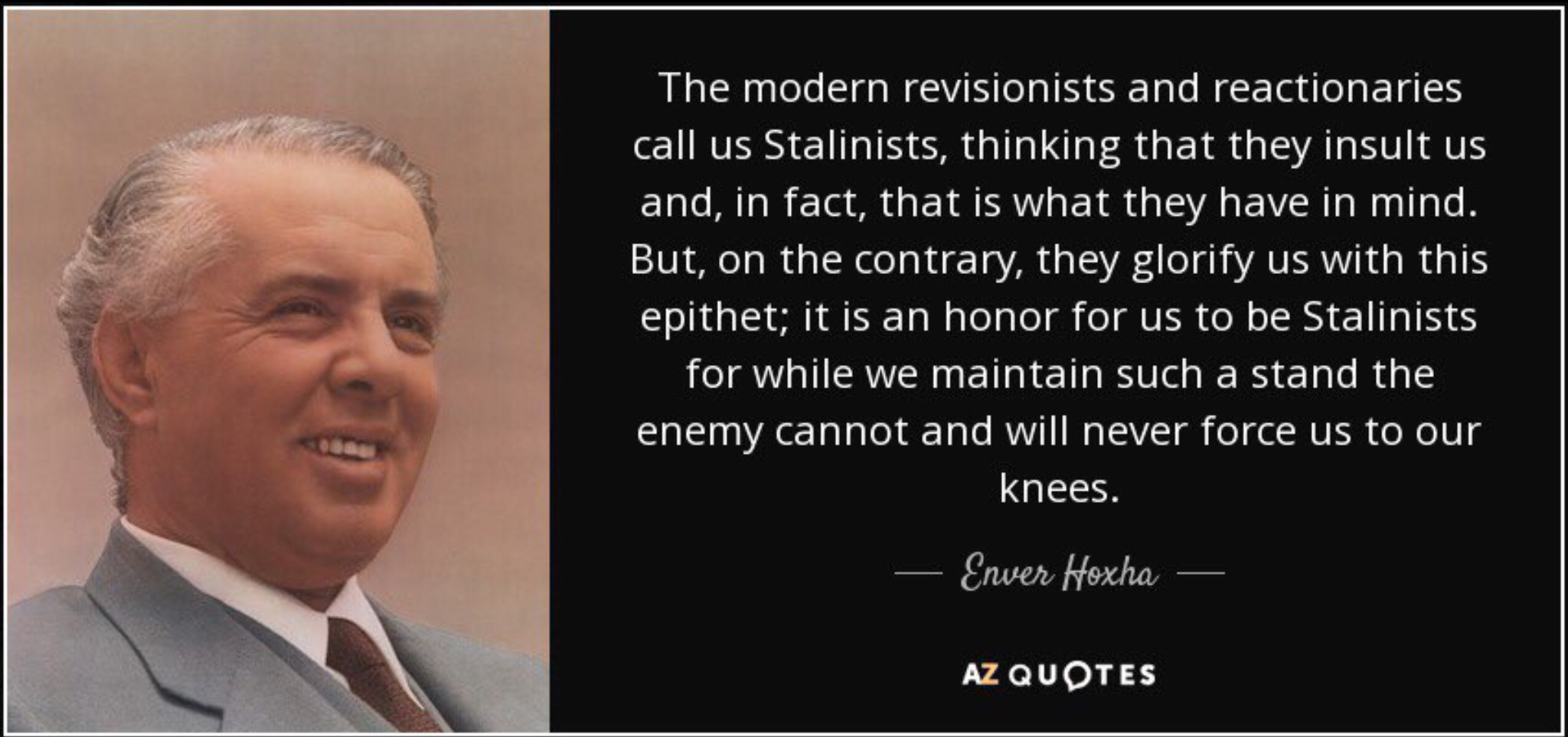
After the death of Joseph Stalin in 1953 and Khrushchev along with his acolytes seizing power in 1956, Anti-Revisionist Marxists, first Maoists and later Hoxhaists, criticised the Khrushchevites for their revisionist beliefs and practices. The rise of Khrushchevism lead to the Sino-Soviet split in 1961. It is these revisionist and opportunistic lines of “Anti-Stalinism” which caused the collapse of the Soviet Union and the dismantlement of the state socialist system of the eastern bloc over a period of 35 years, 1956-1991.

To understand the process of the restoration of capitalism in Soviet society, it is necessary to understand the principles of Khrushchevism and how it differs from Marxism-Leninism. Nikita Khrushchev believed that it was possible for a capitalist society to peacefully evolve and transition into a socialist society via gradual democratic reformism. He also supported the notion that capitalist and socialist states could peacefully coexist. Socialism, as in the public and cooperative ownership of industry and agriculture with central state planning and distribution, has never been achieved through means of democratic constitutional reforms. In order for a socialist mode of production to be established by the ballet box, industrialists and entrepreneurs who ruled bourgeois society would have to stand idly by as their assets were placed into the public sector and their property nationalised. As for peaceful coexistence proposed by Khrushchev, this quixotic, foolish idea could be easily rejected with the fact that the capitalist imperial great powers always were focused on attempting to destroy socialism even before the October revolution. The early Russian Soviet Federative Socialist Republic was invalided with a coalition of 17 nations upon its inception. The police force and military were always used to forcibly crush labour and general strikes and protests by radicalised workers. The West supported Hitler in his early reign due to his extreme Anti-Communist and Pro-Industry rhetoric. It is directly opposed to capitalists’ interests that a bourgeois democratic government take a neutral, rather than hostile, stance to the existence of a socialist republic. Khrushchev replaced the authoritarian Stalinist era politics used to purge opportunists and revisionists from the party with a more relaxed a politically liberal atmosphere, which allowed for right-wing opportunist and Marxist revisionist politicians to take power.

After Stalin, Khrushchev took power and led the whole Soviet social system down capitalism. He represented the new state-monopoly bourgeois class which had sprung up from the ideological parts of the superstructure which had been left unchanged. Bourgeois ideas were able to be sowed into the party because of people who lived their lives under bourgeois society and lived by its ideas. There were those who were strong and socialist to the end and those who were very weak, like, Khrushchev who succumbed to it. There was a large amount of militarisation, too much to be called simply “militant defense of the revolution.” There was also its treatment of other socialist states as client states and upheld a line of “limited sovereignty.” The Comecon allowed the U.S.S.R. to exploit resources from these client states, for example, over 90 percent of Czechoslovakia’s uranium production, 94 percent of Bulgaria’s bauxite exports and 49 percent of its lead and 43 percent of Poland’s zinc went to the Soviet Union, etc.

What doesn’t make it imperialism? The U.S.S.R. under Khrushchev by that time stopped developing nations in order to reach more or less self sufficiency, and to supply the Soviet Union with raw resources. This is already financial capital. They export financial capital to, say, Cuba to develop their nickel and sugar industries, Cuba exports the nickel and sugar and the U.S.S.R. sells to them finished products. Technological development was barred in Uzbekistan, the U.S.S.R. wanted Albania to remain an agricultural country. So it is not an inappropriate usage, nor is it a misunderstanding of the Marxist definition because the USSR did have all the necessary characteristics that would make them imperialist. They had monopoly in industry, exported surplus capital in order to develop other nations’ economies, but this development only served to provide them with superprofits.

Basically, Khrushchev represented the interest of the growing bourgeois class. Classes don’t disappear under socialism, this is a mistake Stalin made and even to an extent, Mao and Hoxha, and it cost them gravely. Instead of continuing to get rid of the bourgeoisie in culture, ideology and the other branches of the cultural superstructure, they only focused the economic expropriation of the bourgeoisie, severing them from the state. The bureaucratic managers of the state owned means of production that became evident during Khrushchev’s take over shows how the bourgeoisie had obviously been growing, and through the class struggle, expressed themselves with their representative, Khrushchev, now in power.

Capital between banks and industries had already a firm relationship under the socialist period of the U.S.S.R. but this can’t be called financial capital since the U.S.S.R. was still a workers’ state. However, during Khrushchev’s take over, the means of production were effectively severed from the workers, despite there being Soviets and state planning. We know for a fact that the democratic structures of society are meaningless if the bourgeois class rules them. It is evident that this became financial capital in that the USSR began to invest more in its allies and extract resources from them, greatly hindering them from their task of industrialisation.

After 1985, when Gorbachev was in power, the latent CIA-backed Bourgeois Nationalist movements supported both Gorbachev and Yeltsin, who demanded more radical political and economic reforms, most notably economic privatisation and liberalisation schemes. There was also Anti-Socialist propaganda in an attempt to increase their support among capitalist sympathizers. Heroin epidemics, runaway hyperinflation, and enormous spikes in crime further lent its hand in suppressing Socialism. Consider what Mikhail Gorbachev did once he took power:

• He allowed anti-Communist and pro-nationalist political groups to organize and expand their influence unchecked.

• He appointed Russians to lead the other Republics, instead of people native to each Republic, causing distrust between them.

• He completely ignored the advice of his economic advisors and followed his own plans, which as we know, was disastrous, as production was now more focused on luxury goods than what people actually needed.

• As living standards steadily dropped due to his policies, people had to devote more and more time struggling for basic necessities.

• He relaxed price controls, causing the price of staple goods to increase. Individual managers were paying their employees more, which increased the inflation, that combined with shortages of basic necessities.

• He implemented more market reforms, allowing for the further development of the black market.

• He bagan an anti-alchohol campaign, which resulted in disaster. Illegal producers were now becoming wealthy.

• The opening of the press of course opened a floodgate of pro-west propaganda. Soviet citizens were bombarded with false propaganda about the purges, Holodomor, gulags, etc…

• The market reforms drained money away from ordinary people and into the pockets of the people that would eventually become the oligarch class.

• The ordinary working people had become spectators due to the ossification and highly bureaucratised manner the state operated, and they were no longer protagonists in preserving socialism.

• He paved the way for multicandidate, multiparty elections.

• He allowed for private competition with the state gas, oil, and mining companies, of which the public sector cold not keep up with.

• He cut funding to the Eastern bloc nations which allowed them to devolve back to capitalism.

• He agreed to cut back on nuclear testing and dismantle nuclear missiles despite no reciprocal promises from the west, leading to a loss of prestige and international leverage.

The Soviet Union fell due to the revisionism that had grown in the party over time, most notably the Bukharinite trend that had gone from Bukharin to Khrushchev and finally to Gorbachev. The weakening of Party discipline and education (the Party and it’s organs became complacent and stood aside and watched what happened until it was too late, unlike in 1964 when the Party was independent and disciplined enough to remove Khrushchev), and the growth of the Second economy. The growth of the second economy was incredibly important as it gave Revisionism a base from which to stand on and rewarded those who circumvented the Socialist economy, and it itself weakened the Socialist Economy as it took from it. Gorbachev embodied the demands of the Second economy and the Social Democrats that sought to move towards Capitalism, and it was his weak personality combined with his association and involvement with characters such as Yakovlev, Chernyaev, and Shevardnadze among others, that made him shift towards drastic economic reforms that served as the trigger for the dissolution of the USSR. Oftentimes people point to the failing Socialist Economy as the issue but this is false, the economy was not failing in the first years of Gorbachev’s rule, in 1985/1986 as Gorbachev mimicked Andropov’s methods to help the economy with great success.

Andropov’s methods worked to help the economy with great success. Andropov showed that the economy could get out of its stagnation, and when Gorbachev mimicked Andropov’s methods in 1985 and early 1986 there were signs of growth. In 1985 and 1986 production and consumption increased, economic growth went up from 1 to 2 percent, productivity increased from 2-3 percent to 4.5 percent, agricultural production grew by 5 percent and the consumption of goods and services increased by 10 percent in 1985 and 1986, 1.5 times greater than the preceding years. Life expectancy also rose and child mortality lowered for the first time in twenty years. This is good for just over a year of implementing these reforms. But it was Gorbachev’s advisors that turned a weak Gorbachev towards market reforms, and it was in December 1987 when Gorbachev, pushed by Yakovlev, forced half of state industry to sell to the market by cutting state orders by half. This would result in an economic slump that the USSR would not recover from and the introduction of inflation for the first time since the Second World War, inflation being an aspect of a market economy, not a planned one. It was Gorbachev’s reforms and actions that killed the USSR, spurred on by his Social-Democratic advisors as well as Imperialist states, but the roots of his actions and the conditions that he worked under have to do with longstanding trends such as the Second Economy and the continuation of the Bukharanite trend of Social Democracy.

Sources and Information:

https://www.marxists.org/subject/china/peking-review/1975/PR1975-13d.htm?utm_source=share&utm_medium=ios_app&utm_name=iossmf

https://www.marxists.org/history/erol/uk.secondwave/cfb-su.htm

https://www.marxists.org/reference/archive/mao/works/1964/phnycom.htm?utm_source=share&utm_medium=ios_app&utm_name=iossmf

http://www.marx2mao.com/Other/RCSU75.html?utm_source=share&utm_medium=ios_app&utm_name=iossmf
Neo-Colonialism: Modern Imperialism and Zionism in the Near Eastern Struggle.

Note: I am not Anti-Semitic in any way. I am opposed to all forms of bigotry and racial/ethnic discrimination. This blogpost is dedicated to my personal views and knowledge of Anti-Imperialism against the state of Israel and the West. Thank you for reading. Sincerely, Anthony.

The primary threat to the liberty of the Arab working people is of course the United States and the state of Israel. The opposition to the Palestinian peoples can thus be interpreted as acts to preserve the Israeli territorial imperialism and Western semi-colonisation represented by oligarchic Arab oil barons and American politicians. I shall now proceed to explain why, in my viewpoint of the matter, the movement which emerged in 19th century Britain known as Zionism was born out of racism and is now only useful to maintain Western dominance over post-colonies in the Near East.

In order to start of, it should be noted what Zionism is to better understand the movement of anti-imperialism against Israel. Zionism is a political ideology mainly based on ethnic, religious, and cultural identity which emerged in the second half of the 19th century with the goal of establishing a permanent homeland of the Jewish people in the region of Palestine. Zionism is not actually a tenant of Judaism, as it is written in the Torah that the Jewish people shall not claim a state until the messiah arrives to grant it to them. It is instead a tool used by the great powers of the West to gain a considerable level of economic leverage and military dominance over the region. When you consider the fact that the Near East has a significant amount of natural resources, specifically petroleum and natural gas, this of course makes perfect sense. However, most Jews have found being themselves subjugated to conform to the beliefs of the warmongering, bigoted, and perilous structure of neo-colonialism, hence the reason the Jewish people are mostly ignorant of the nature of the system and why they should be opposed to it. This is also why people who strongly believe in Zionism will claim you are an Anti-Semite if you happen to not stand with Israel. Standing against a nation state that is massacring the Palestinian people to maintain dominance over the natural resources and have political supremacy over the region isn’t hatred of the people who live in said country. It is not just a criticism of the state, but an opposition towards racism and territorial expansion.

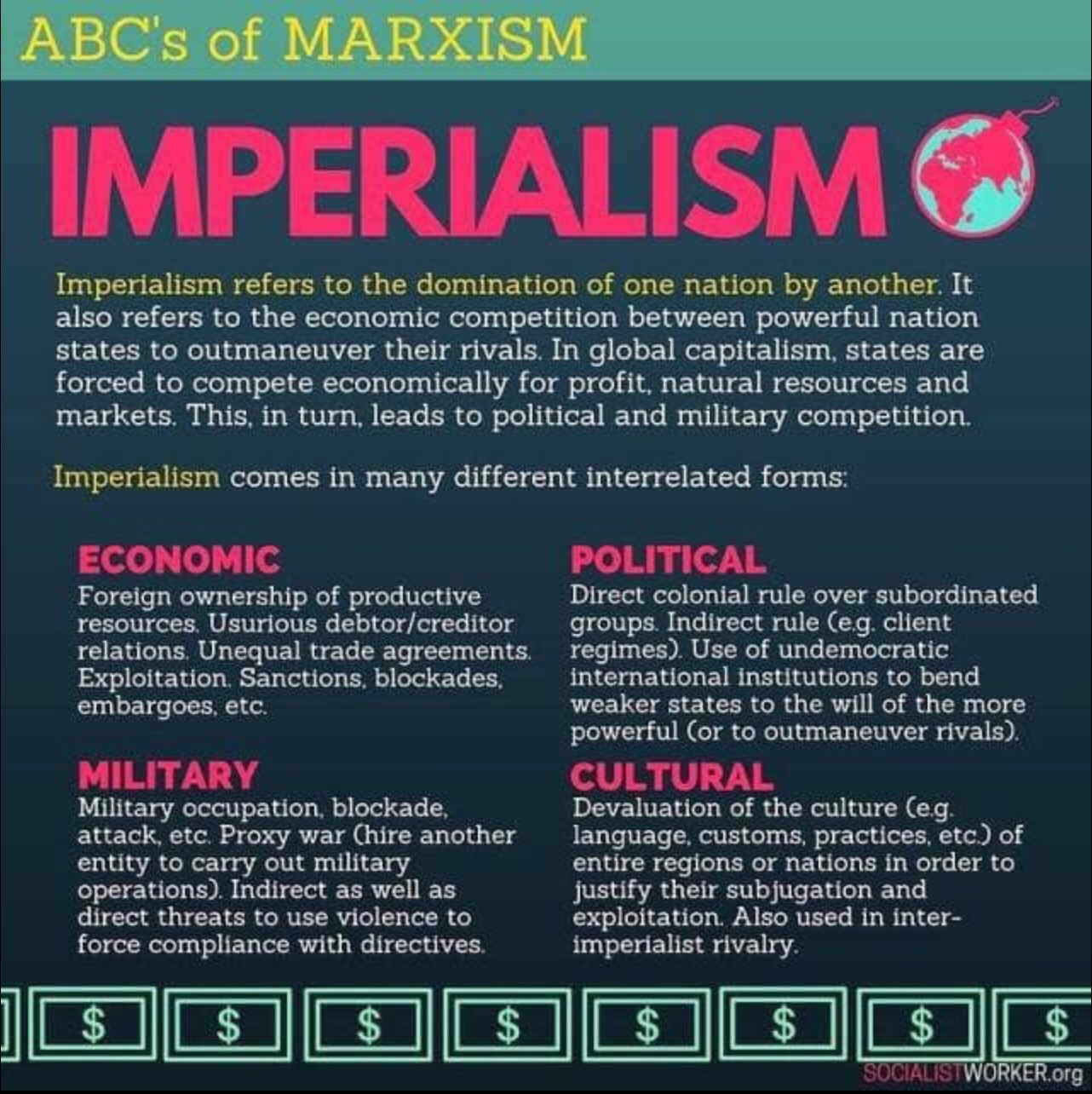
Next, imperialism and colonialism must be properly defined. Colonialism is defined as the policy and practice of acquiring complete or partial political control over a set territory with the purpose of exploiting the territory economically. The colonialism of the 19th century and previous to that does have similarities to modern imperialism, however, they are very different. Imperialism is a certain response to the contradictions of capitalism inherent to the system. As the rate of profit has a tendency to fall as competition in the market and innovation and automation of labour occur, increasing the ratio of machine capital to human labour which drives down wages and lowers consumption, capitalism enters stages of decadency and crisis. This decadency can be seen in the form of very severe economic recession or depression, such as the panics and crises of 1929 and 2008. Capitalists can no longer acquire a profit from exploiting workers in their home country. Industrialists must then turn to the economic exploitation of the developing world for their cheap labour and natural resources in order to sustain profitability. Vladimir Lenin marked imperialism as containing these characteristics:

1. Change in the function of capital: The exportation and importation of capital between countries, similar to the commerce of consumer goods.

2. Changes in the conventional form of capital: The merging of industrial capital and banking capital for the formation of financial capital.

3. Suppression of free market competition: The creation of monopolies, oligopolies, cartels, and trusts dominating the economy and pursuing a collective interest on a profit basis.

4. Rise of the Banking System: Owners of banks will buy extremely large amounts of shares of stock in industry to dominate over the economy.

5. Political, Economic, Cultural, and Military domination by the developed most advanced capitalist great powers of the developing world for their cheap labour and natural resources.

6. A “Labour Aristocracy” being created in the West, supported by the toiling wage slaves of the underdeveloped overexploited earth. These much better off workers will begin to align with their bosses and class consciousness will be destroyed.

The primary world contradiction under capitalism, that a worker can never buy back the full value of their own labour, is what makes capitalism an inherently unstable and unsustainable system. It is the evil and greedy ventures of colonialism, war, and imperialism which have delayed the triumph of the worker’s struggle in the creation of world socialism. First, Latin America is divided into puppet and client regimes ruled by dictatorial tyrants in the interests of the United Fruit Company, suppressing trade unionism and using their militaries to kill workers who toiled in slave-like conditions for attempting to gain their labour rights. Now, as the global petroleum industry plays a major role in the American economy, the Near East, which has been under the influence of the West since the Great War, is carved up and threatened by the United States military in the pursuit of profit.

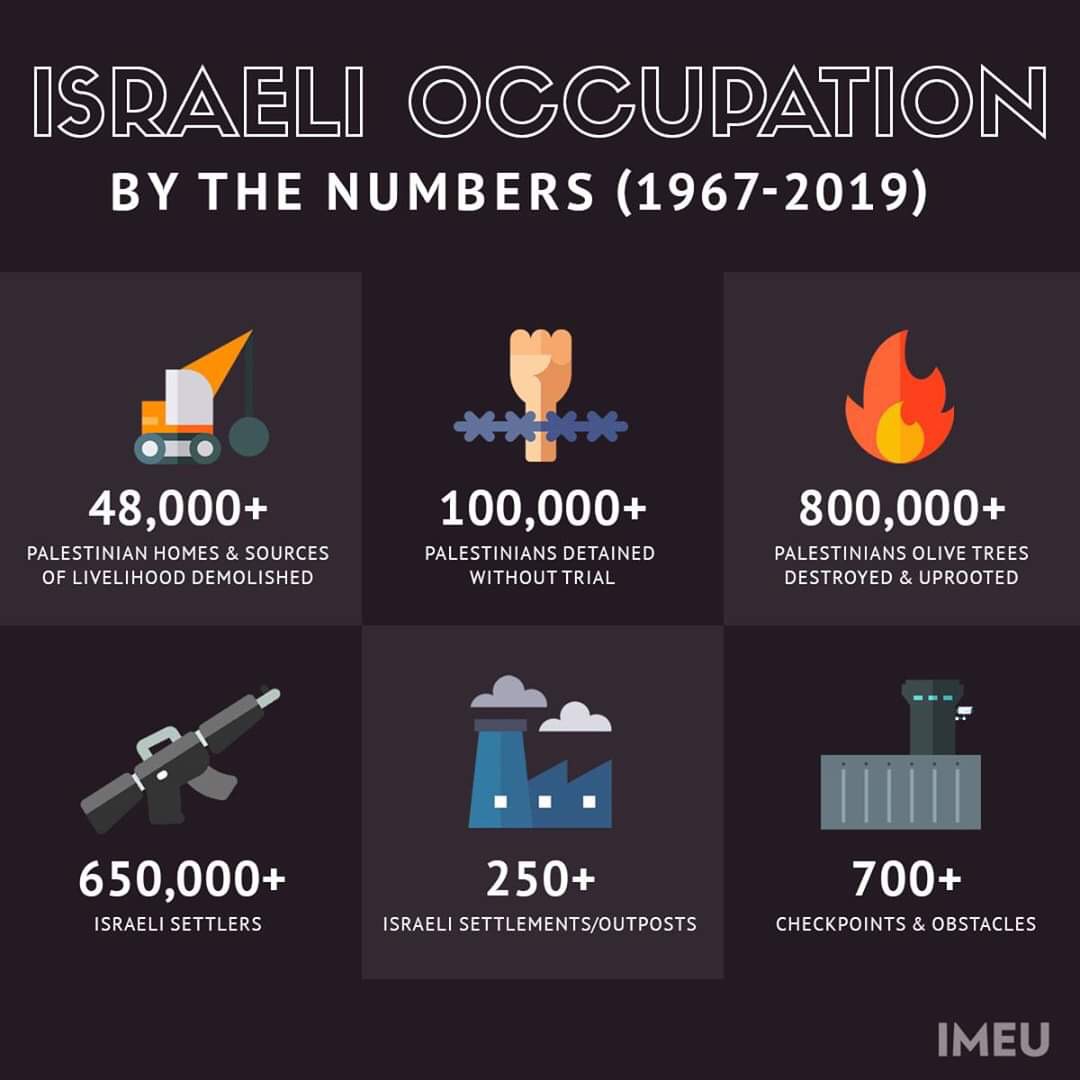
While Labour Zionism, the left-wing of Zionist politics, dominated Israel’s government well into the 1970’s, this progressive, egalitarian, and worker oriented ideology still excluded Palestinian Arabs from the process of attempting to construct a Socialist or Social-Democratic society. Modern Zionism in Israel possesses a nationalistic mentality, contributing to the Apartheid system affecting the Palestinians. Under the Right-Wing Nationalist government of Israel, Palestinians have suffered through extrajudicial killings, mass detentions, housing demolitions, forced migration, relocation, and large-scale deportations. Increasing Jewish settlements of Palestinian territory have been resisted with civil disobedience and non-violent protesting on a widespread scale, to be dealt with by the state of Israel with military deployments and massacres of those who took matters into their own hands.

The state of Israel is a major part of the West’s neo-colonial and geopolitical strategy in the Near East. Its government aids in counterterrorism against Anti-Western groups to defend the financial interests of American and European economic elites. Israel wishes to impede the natural gas revenues in Gaza from continuing to be in the hands of groups such as Hamas as they are not submitting to the Israeli interests. We must put an end to the lobbying agenda which reflects Israel’s political establishment and exercises influence of the West. Israeli society has thrived via the dehumanisation of the Palestinian Arab Muslims and Christians. By dividing the Israelis and Palestinians by seeing each other as enemies, a rather significant portion of Israeli society has lost all empathy for the Arabs, providing a justification for their maltreatment and genocide.

The right-wing, ethnocentric, and bourgeois nationalist Zionism has been proven to be incompatible with parliamentary democracy as it would lead to the creation of a multinational state where different ethnicities could peacefully coexist under a shared political institution. It can then be inferred that Zionists in government would not willingly agree to grant different ethnic and religious groups the same civil liberties as Zionist Jews. This can partially explain why the Israeli political establishment has chosen to blatantly ignore international law and pursue a path of colonialist war and an ethnic policy of Apartheid. Western countries are politically and economically incapable of attempting to stop or even opposing the actions of the state of Israel. It is civilians all around the world that are the best hope in placing political pressure on Israel to once and for all, create better economic conditions for the working people of the Near East.

Marxist Revisionism: A brief history.

After the deaths of Karl Marx and Friedrich Engels, Marxist thought began to be revised by philosophers. These philosophers believed that certain principles of Marxism were false or disproven and should be replaced with others. This is known as revisionism of Marxism.

The modification and revision of Marxism was first done by German philosopher Edward Bernstein. Bernstein rejected important Marxist principles such as the labour theory of value, economic determinism, and the significance of class warfare. He also interpreted the progression of western civilisation as disproving some of Marx’s predictions of capitalism. Bernstein asserted that the middle class was not vanishing but rather growing, that there was not even more income and wealth inequality with capital in the hands of fewer and fewer people, and that the working classes were becoming better off and generally more affluent. Now, Edward Bernstein believed that revolution was simply unnecessary for socialism to be established as, in his mind, capitalism would naturally and gradually evolve into socialism. This form of Marxist revisionism is known as “Evolutionary Socialism”. Despite the fact that every economic system since the agricultural revolution has been brought about by violent social revolution and war, he saw the rise of universal suffrage and labour law as being the foundations for socialism. He thought that universal suffrage would allow for workmen to vote for the new emerging Labour Parties and Worker’s Parties so Anti-Capitalist politicians could pass and implement gradual parliamentary social reforms which would benefit the working class. Labour law, which was established by the workers who organised in trade unions to establish, protect, and guarantee their labour rights, was another stepping stone towards the end of capitalism as Bernstein believed that because labour law reduced the amount of hours a worker can work, raised wages, and improved working conditions, industrialists could no longer exploit workers as much. Bernstein also believed that colonialism was good as it spread capitalism to Africa and Asia. This belief is known as social imperialism. It holds that as capitalism was being spread, it would allow for socialism to be established more quickly.

After Bernstein’s death, Marxist revisionism had largely died out, only to return in the early 1950s following the death of Joseph Stalin and Nikita Khrushchev taking power. Khrushchev was profoundly Anti-Stalinist, focused on consumer goods much more heavy industry and nuclear weapons, was very liberal in terms of censorship of art and literature, and negated the need of socialist and Marxist revolution in the developing world. State capitalism began to emerge in 1955 and a year later, he gave his infamous “Secret Speech” denouncing Stalin. Communists and Marxist-Leninist intellectuals saw this as treachery to international working class movements and to the goal of world communism. Khrushchev’s policies lead to Mao Zedong orchestrating the Sino-Soviet Split in 1961.

While Edward Bernstein’s Evolutionary Socialism and Khrushchev’s Anti-Stalinism are clear examples of revisionism, Soviet and Albanian writers described Maoist and Post-Maoist China and Tito’s Yugoslavia as being revisionist. While the Albanians stayed true to Marxism-Leninism and the Soviets took the path of economic privatisation and liberalisation, Tito and Mao were not revisionists. Tito was a market socialist who allowed for more freedom in art and literature as well as more worker’s self management, and Mao was a theoretician who made contributions to Marxism and massively helped his fellow countrymen.

Eurocommunism, also known as neocommunism, was a political system advocated by some communist parties in western European countries, stressing independence from the former Soviet Communist Party and preservation of many elements of Western liberal democracy. This revisionist trend was popular in the 1970s and 1980s. Its support for the parliamentary liberal democracy of Western Europe would have effectively destroyed the concept of the Dictatorship of the Proletariat.

The greatest example of Marxist revisionism is without a doubt Socialism with Chinese Characteristics, or Deng Xiaoping Theory. Upon the death of Mao, Deng took over as leader of China and had massive market reforms for economic privatisation and liberalisation. But Deng didn’t do this to destroy his country like the Soviets did. He did this to have more economic growth. The economy of modern China now reflects that of Lenin’s New Economic Policy and the polity is an authoritarian police state and bureaucracy. Of course, remnants of socialist democracy still exist in China as elections are held, but political freedom and individual liberty is limited.

Historical and Dialectical Materialism: The core of Marxist Thought

Within the proletarian Marxist movement and Marxism itself, two fundamental principles and beliefs of Marxism are extremely important to the philosophy. The methods of historical and dialectical materialism are used by Marxists to analyse history and human society through a scientific basis.

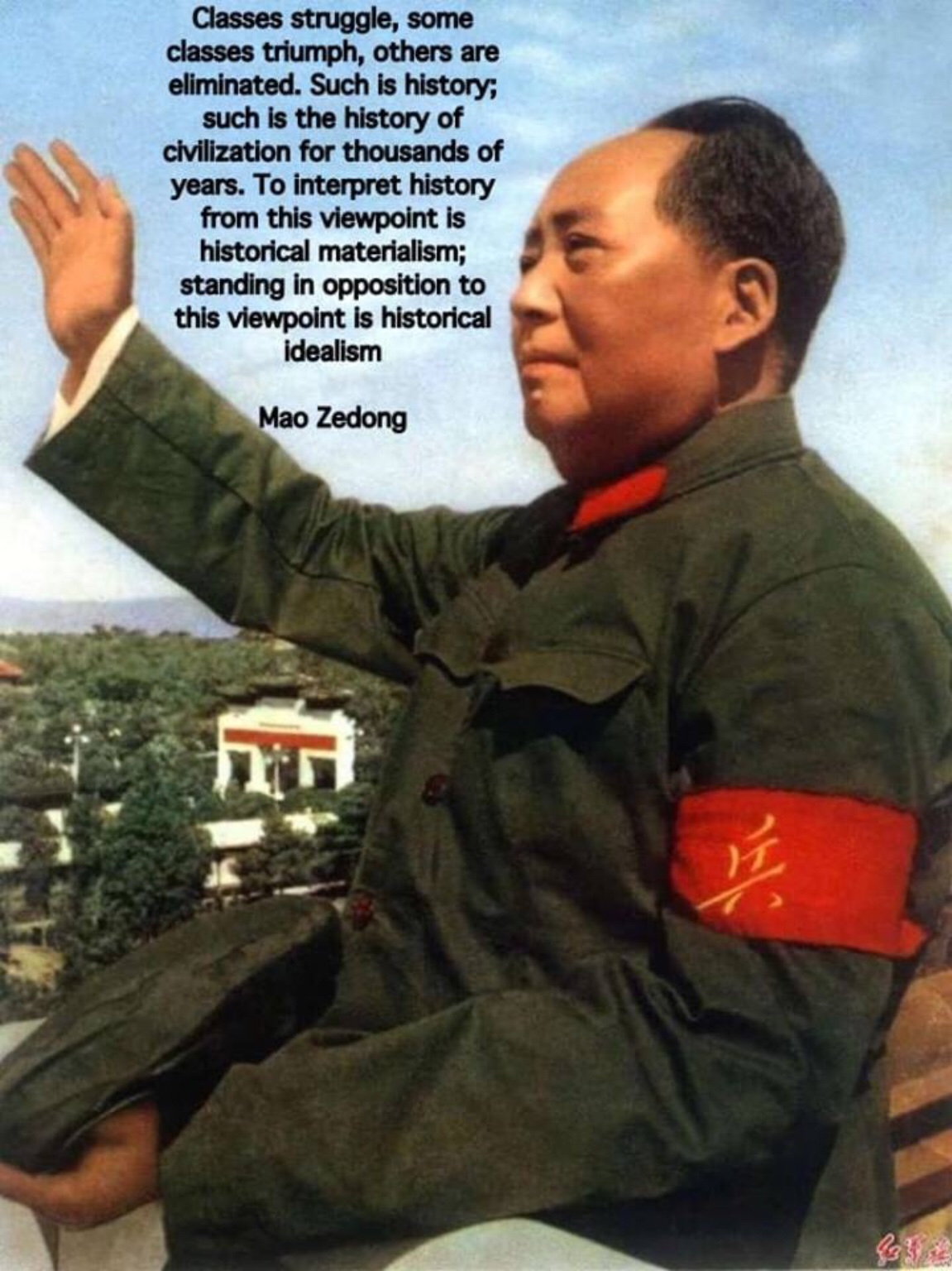
Historical materialism is the belief that the entire history of human society after the agricultural revolution has been a history of class struggle and conflict. The ultimate cause of all social changes, according to Marx, isn’t found to be the result of the human brain and mind, but in the changing of the mode of production. Marxists do not view history as a simple series of isolated objective facts, they seek to discover the general processes, principles, and laws that govern human nature and society.

Human society has historically gone through several stages of development. Before the agricultural revolution, humans lived under primitive communism. This was before the concept of private property existed. Primitive communism was pure tribal democracy and communalism where all able-bodied adults worked for the commonwealth of the entire commune and all goods were owned in common. Eventually the limited amount of resources lead to the discovery of agriculture. Out of the laziness and selfishness of people slavery was born. Individual communes had varying degrees of resources which created war to acquire such resources and the prisoners of war captured became the private property of others, forced labour and servitude.

After the economies of the Athenian and Roman empires collapsed and Germanic barbarians conquered Europe, feudalism was established. This economic and political system placed the king at the top, followed by the nobility, the clergy, lords and knights, peasants, and serfs. The king owned all land, in which he would grant some to the nobility and vassals (lords and knights) in exchange for military service to him. Villeins (peasants and serfs) would live and work on this land in order to survive and would provide the vassal with a portion of their harvest. Over time the merchant class which had been present for millennia started to grow. On the Italian coast there were maritime aristocratic republics dominated by the merchants. As time passed and the industrial revolution occurred, feudalism died out in most of Europe. The French Revolution was a bourgeois revolution inspired by classical liberalism and lead by the powerful mercantile class. This mercantile class evolved into the bourgeoisie of today.

Capitalism is now the mode of production used by the vast majority of the world. It is an economic system characterised by private ownership of the means of production by individuals. It is based on three pillars of wage labour, capital accumulation, and private property. Under capitalism workers sell their labour-power to the capitalist to operate the means of production. The value created by the workers is taken by the capitalist as profit, therefore leading to exploitation. Capitalism, like the slave economy and feudalism, cause cyclical economic recession due to their inherent structure. Because there is a finite amount of resources, land, and people on earth and capitalism requires ever growing expansion, the system will fall apart as every past system has. Workers will have no choice but to engage in class warfare or to risk starvation in order to establish socialism and the inevitable communism.

Dialectical materialism is the Marxist theory that political and historical events result from the conflict of social forces and are interpretable as a series of contradictions and their solutions, of which the conflict is caused by material need and conditions. For Marx and Engels, materialism meant that the material world, as perceived by our senses, is objectively real outside of the human mind. They didn’t refute the reality of mental processes but rather that ideas could arise only as products or reflections of material conditions. Dialectical materialism believes that class struggle and conflict is the ultimate driving force of human history.

The theory of knowledge of Marx and Engels started from the materialist premise that all knowledge is derived from the senses. But it is against the mechanist view that derives all knowledge exclusively from given sense impressions, they stressed the dialectical development of human knowledge, socially acquired in the course of human activity. Thus, individuals can gain their knowledge only through practical and logical interaction.

Social Class in Capitalist Society

In the capitalist mode of production, social classes are based off of the relation between ownership and operation of private property and the means of production. Understanding and analysing class division and struggle is very important in understanding the nature of capitalism.

In capitalism, there are two main classes; the bourgeoisie and proletariat. They can both be broken down to two subclasses. In the bourgeoisie there are industrialists and the petite bourgeoisie. In the proletariat there is the labour aristocracy and the commoners. There is also an underclass, called the Lumpenproletariat.

The bourgeoisie is the employing class, the property holding class. The members of the bourgeoisie own capital, or assets which have the potential for the creation of more wealth. This capital is in the form of the means of production ( factories, machinery, farmland etc) and other forms of private property (something owned which can be used to exploit others). An industrialist is someone who owns a lot of private property and the means of production. Their income is made from this ownership. Despite owning the means of production, industrialists do not operate it. Instead they hire people who do not own the means of production to operate it for them.

The petite bourgeoisie is made up of small business owners and the self employed. They own some of the means of production and they do operate it. However, they also tend to hire workers to boost their profits. A decent portion of their income comes from their own labour, while the rest comes the exploiting the labour of a few others.

The proletariat is all people who do not own the means of production or any other form of private property. They sell their labour-power (the ability to work) to someone who does own it in order to live. They operate the means of production for wages.

The labour aristocracy is made up of workers who strongly benefit from super-profits extracted from ordinary workers. Most members of this subclass are actors, doctors, lawyers, or very skilled workers.

The commoners are simply ordinary people. They have only one valuable asset, labour-power, and only labour-power. Their psychical and intellectual labour goes to the production of commodities (goods which are bought and sold) and the capitalist sells the commodities produced by their workers for profit. After all production costs have been paid, the capitalist pays the workers only part of the amount of value added to the raw materials the commodities were made from, thus leading to an exploitive social relationship between the bourgeoisie and the proletariat.

The Lumpenproletariat is the social underclass of society. Members of this class neither own property nor operate it. It is composed of pickpockets, prostitutes, burglars, beggars, loansharks, and mobsters. Their income is made through preying on the proletariat.

Design a site like this with WordPress.com
Get started